
Introduction
Belgium, a
small and open economy of 11.4 million inhabitants, is located in the heart of
Europe. The economy benefits from a strong communication infrastructure and a
highly qualified workforce.
Real GDP
Growth data in Belgium is updated quarterly. Belgium’s GDP expanded 0.4 percent
on quarter in the three months to December 2018, the same as in the previous
period and in line with preliminary estimates. Household consumption (0.5
percent vs 0.7 percent in Q4) and gross fixed capital formation (0.1 percent vs
0.4 percent) slowed while government expenditure rose faster (1.1 percent vs
0.5 percent). Also, foreign demand contributed negatively to growth, as exports
rose 0.6 percent (vs -0.4 percent) and imports increased at a faster 0.9
percent (vs -0.3 percent). Year-on-year, the GDP advanced 1.2 percent, slowing
from a 1.6 percent expansion in the previous period and also matching earlier
estimates. It was the lowest annual GDP growth since Q2 2014. Considering 2018,
the economy advanced 1.4 percent, the least since 2013 and below a 1.5 percent
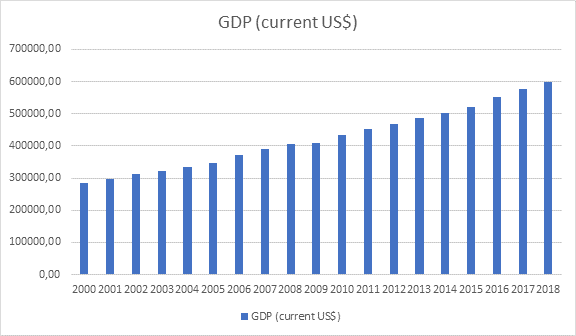
gain in 2017. So, the data reached an all-time high in 2018 and a record low in
2000 year.
Table
1 GDP – Belgium 2000-2018
Regression
analysis
A correlation
analysis was carried out of the relationship between the endogenous indicator,
which is understood in this case as the GDP and exogenous indicators from 2001
to 2018.
 – the endogenous parameter
(the GDP).